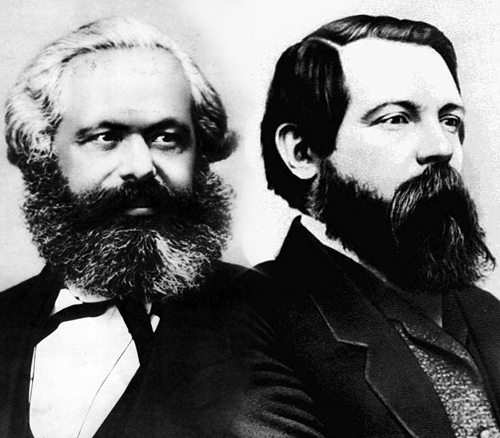
Karl Marx (1818-1883) and Friedrich Engels (1820-1895) are the founders of socialism.
Key Ideas
Social Class: Marx and Engels argued that society is divided into classes based on economic relationships. There is constant conflict between the bourgeoisie (owners) and the proletariat (workers) that drives history and politics.
Human Nature: Humans are social beings, shaped by their material conditions. True human potential can only be realised in a classless, cooperative society. In a society based on private property, individuals are
alienated from their work, each other, and themselves. This causes people to become disconnected and dehumanised, often leading to social problems.
Historical Materialism: History is shaped by material (economic) forces, not ideas. Ideas are a reflection of economic conditions. The way people produce and distribute goods determines the structure of society and how it develops.
Dialectic Change: Change occurs through conflict between opposing forces. These forces are the bourgeoisie and the proletariat. The conflict between the owners of property/production and the people who work it has been ongoing throughout history. This is seen through
class struggleThe ongoing conflict between different social classesbea..
Class struggle will lead to revolutionary transformation which results in the creation of new social systems.
Revolutionary Class Consciousness: The working class must become aware of its exploitation in order to unite and overthrow capitalism. Only through revolution can a fair and equal society be achieved.
Influence
Their theories inspired socialist and communist movements across the world. An example is the Russian Revolution of 1917 which caused the rise of the Soviet Union (USSR).
Marxism remains central to debates about class, inequality, and the nature of capitalism. To this day, there are movements and political parties that draw on Marxist ideas. For example, the Labour Party in the UK has had Marxist influences in its history.
Marxism has been criticised for its association with authoritarian regimes and seen as a threat to personal freedoms.
Key Works
The Communist Manifesto (1848) - A summary of Marxist theory.
Das Kapital (1867) - Marx's analysis of capitalism.